Architecture
This page is the technical map of AgentGem: how a request flows from a client, through the contract surface, into the framework-agnostic Gem core, and out to archives, targets, and local testbeds and runs. For the conceptual "why," read Concepts first.
The big picture
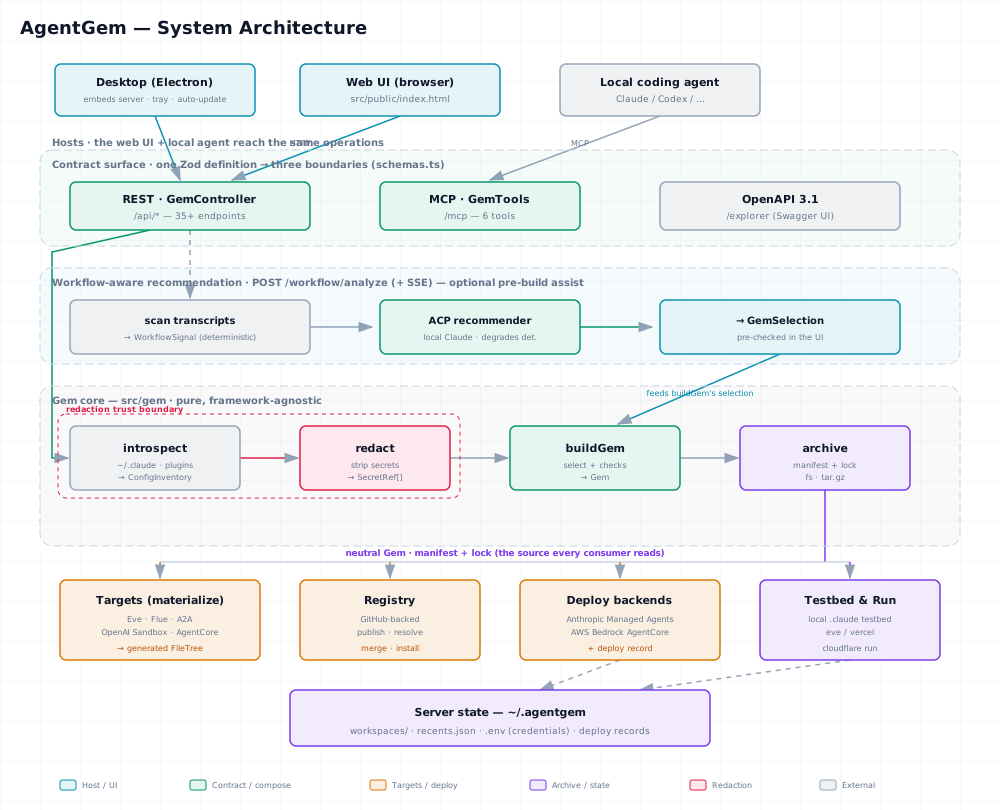
Diagram:
diagrams/system-architecture.svg· PNG · interactive HTML (Copy / PNG / PDF export)Two subsystems get their own detail diagrams: the memory-sync bridge and the benchmark feedback loop; the desktop client/server split is in its own diagram.
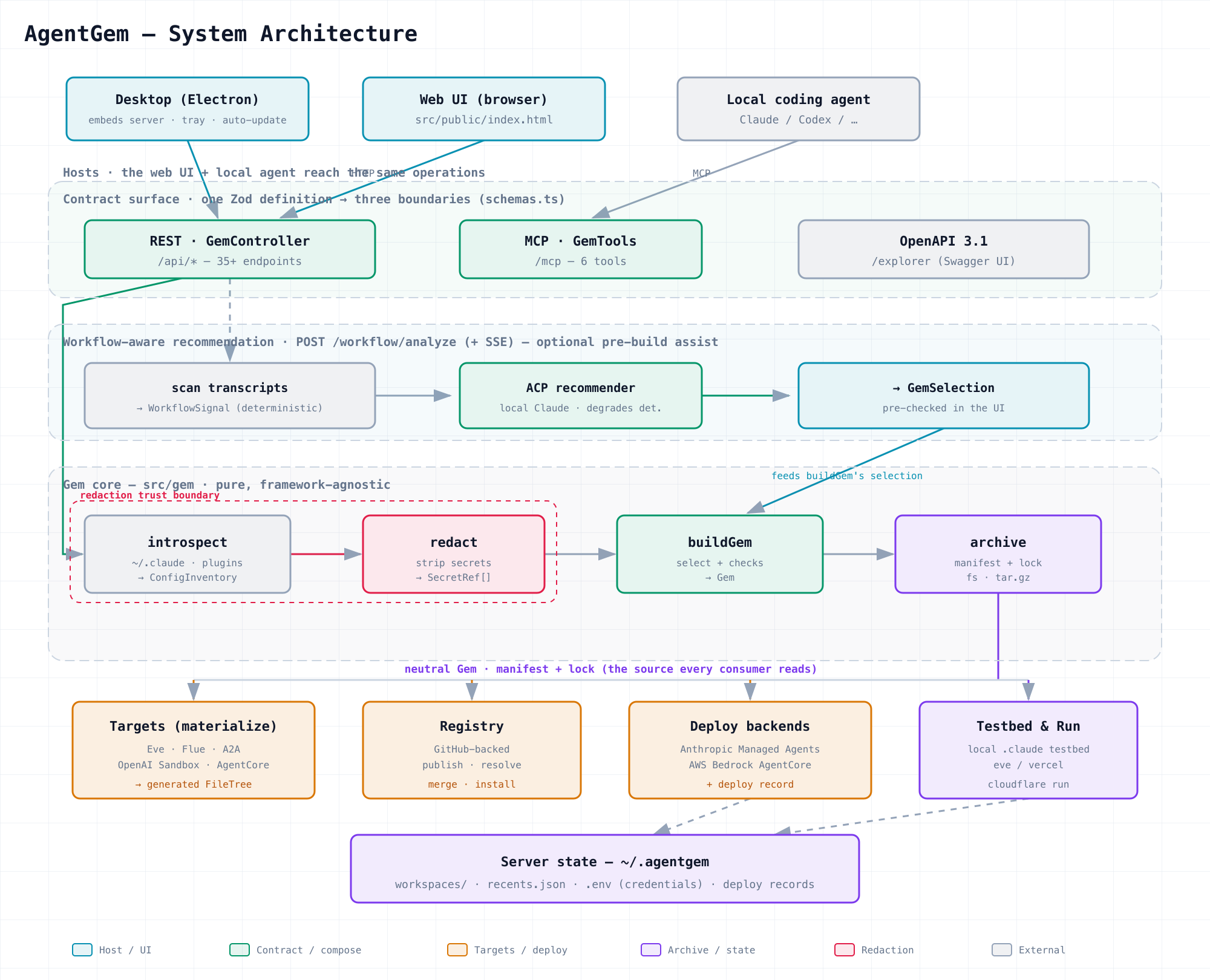
There are four main horizontal bands:
- Hosts / clients — the web UI (
src/public/index.html), any local coding agent, and the Desktop app, which runs the same core in client mode in Electron (tray + auto-update). - Contract surface — one Zod definition per operation, surfaced as a REST endpoint, an MCP tool, and an OpenAPI 3.1 document. See the one-contract model.
- Gem core (the
@agentgem/*packages) — pure, framework-agnostic functions:introspect→redact→buildGem→archive. See the build pipeline. - Distribution — the neutral Gem feeds targets (materialize), the marketplace, and local testbeds/runs. See distribution below.
An optional workflow-aware recommendation path sits in front of the core: POST /workflow/analyze (plus an SSE progress stream) scans a project's Claude transcripts into a
deterministic WorkflowSignal, then runs two local ACP agents concurrently — one clusters
and names candidate Gems (degrading to a frequency ranking if the agent is unavailable), the
other distills new draft skills from the recurring builtin procedure the scan would otherwise
discard. It emits a WorkflowAnalysis of pre-checked GemCandidate[] plus DistilledSkill[]
drafts; both feed buildGem (an accepted draft is staged into the inventory by name). The
recommender only ranks what introspection already found; distillation is the deliberate exception
— brand-new drafts behind a human-review gate. See Analyze.
A parallel session-intelligence surface reads the same transcripts for a different purpose: search (Recall), context-hygiene scoring, an aggregates-only chat/MCP, and Play mini-games. It's described in Session intelligence below and is independent of the Gem-build spine.
A bottom band — the community marketplace (app.agentgem.ai) — is a separate
hosted service (operated by ninemind, shared by both editions) that
the console signs into and publishes to: better-auth identity (GitHub / Google / X
/ passkeys) with /@handle profiles, the catalog and its publish scopes /
versioning, and stars / reviews. Contributing to the opt-in, k-anonymized
benchmark feedback loop is available to
any core; groups, orgs, review-gating, and benchmark governance are
Enterprise. The console (and the desktop app) carry
none of this in-process — they talk to the service as a pure client (see the
client/server split).
Server-side state lives under ~/.agentgem (workspaces, recents, credentials) — never
inside a Gem.
The one-contract model
AgentGem is built on AgentBack. The entry point src/index.ts wires a single
RestApplication with both an HTTP server and an MCP server:
const app = new RestApplication({});
app.configure("servers.RestServer").to({ port, host: "127.0.0.1" });
app.component(MCPComponent);
app.configure("servers.MCPServer").to({ name: "agentgem", version: "0.1.0", transports: { stdio: false } });
app.restController(GemController);   // REST  → /api/*
app.service(GemTools);              // MCP   → /mcp
await installExplorer(app, { title: "agentgem API" }); // OpenAPI + Swagger → /explorer
await installMcpHttp(app);
| Boundary | Surfaced by | Path | Notes |
|---|---|---|---|
| REST | GemController (@api) |
/api/* |
35+ endpoints; the stateful surface (workspaces, run, publish) |
| MCP | GemTools (@mcpServer) |
/mcp |
6 tools; read + plan operations for agents |
| OpenAPI / Swagger | installExplorer |
/explorer |
Derived from the same Zod schemas |
| Web UI | Express route | / |
Serves the single-page builder |
REST and MCP are not parallel re-implementations: both call the same helper functions
(e.g. introspectAll, buildGem) and validate against the same schemas in
src/schemas.ts. The REST surface simply adds the stateful operations (workspace CRUD,
run, publish) that a UI needs; MCP focuses on the read-and-plan operations an agent
needs. See the full list in the API reference.
Because every operation is decorator-defined, the build must compile with
experimentalDecorators + emitDecoratorMetadata — see Development.
The Gem core (@agentgem/* packages)
The kernel is decomposed into 15 acyclic @agentgem/* workspace packages (pnpm workspaces +
TypeScript project references) — 14 framework-agnostic kernel packages (below) plus the
@agentgem/console UI SPA. The server layer in src/ stays thin
and consumes them via @agentgem/*. They are framework-agnostic — no HTTP, no decorators, just functions over plain
data — which is what lets the same code back a web request, an MCP tool call, and a test. The
pipeline is in The build pipeline; the on-disk result in
Archive format; the trust boundary in Redaction; the full
dependency graph + rationale in the decomposition proposal.
| Package | Responsibility |
|---|---|
@agentgem/model |
Core types (Gem, GemArtifact, ConfigInventory, GemCheck, …), channels, canonicalize, target specs, MCP proxy, identity, config-dir resolution |
@agentgem/capture |
introspect ~/.claude/plugins/~/.agents/~/.codex/~/.hermes + project dirs → ConfigInventory; credentials, recents, usage, draft staging |
@agentgem/base |
Cross-cutting helpers: redaction (redact, secret patterns, leak canary), workspaces, ACP session |
@agentgem/build |
buildGem — select artifacts by name → a Gem (+ checks, requiredSecrets); behavioral + external (skillspector) check scaffolding |
@agentgem/archive |
Lay a Gem out as gem.json (manifest) + gem.lock and verify integrity; serialize to a directory or a deterministic .tar.gz |
@agentgem/insight |
Analyze: transcript scan → WorkflowSignal, default-deny scrub, distill draft skills, ACP recommender, attestation + ingest; context-hygiene detectors + bloat curve + deterministic boundarySegments (cut-here), rubrics |
@agentgem/recall |
Cross-session transcript search: a BM25/FTS5 index (node:sqlite) over scrubbed turns → ranked cross-session moments, proven-use aware (a separate outcomes store boosts artifacts with good downstream results) |
@agentgem/memory |
Two-way sync bridge to external AI memory providers (mem0, supermemory): pull their memories into recall, push scrubbed, consent-gated candidates out through a review outbox |
@agentgem/play |
Mini-games as game Gems: the git-backed ~/.agentgem/miniapps/ registry, scaffolds, the save-time seal + portability gates |
@agentgem/distribute |
Marketplace publish, share/search, curated skill sources, SSRF-guarded fetch |
@agentgem/contract |
The neutral wire contract for the hosted marketplace API — types, signing payloads, zod schemas |
@agentgem/run |
Run/verify a Gem; local OS sandbox + ACP run; run a materialized project locally |
@agentgem/testbed |
Install a Gem into a local .claude/.codex/.hermes testbed; flavor detection |
@agentgem/transfer |
NATS store-and-forward Gem transfer: seal, ticket, mint, object store |
The conceptual pipeline introspect → redact → buildGem → archive therefore spans
capture → base → build → archive; the optional Analyze / workflow-aware path
(scan → distill drafts → recommend, see Analyze) lives in @agentgem/insight.
Session intelligence (Recall, hygiene, chat, Play)
Alongside Gem-building, AgentGem reads, searches, and grades your session history. This
half is served from src/goldmine/* and src/warm/*, backed by @agentgem/recall,
@agentgem/insight, and @agentgem/play, and surfaced in the console under the Observe and
Build phases. See Recall, Context hygiene,
Chat, and Play.
- Recall (
@agentgem/recall,src/goldmine/recallRoutes.ts) — a local BM25/FTS5 index (node:sqlite) over scrubbed transcript turns. Search is instant and deterministic; the deeper read (chat/extract "exits") runs a cappedask_sessionfan-out plus a synthesis pass over an ephemeral, read-only ACP subprocess. - The
agentgem-goldmineMCP server (src/goldmine/mcpServer.ts,agentgem-goldminebin) — the same intelligence as six MCP tools (search_sessions,search_session_content,summarize_session,ask_session,get_artifact_detail,get_behavior_findings). Its surface is intentionally aggregates-only: the caller seessummarize_session(a deterministic roll-up: process quality, stage mix, detector findings) andask_session(a separate ephemeral agent reads one raw transcript and returns only the answer). Raw transcript content never enters the caller's context — the Insights Generator pattern. - Chat (
src/goldmine/chatRoutes.ts) — drives a local ACP agent (Claude/Codex), read-only, provisioned with the goldmine MCP so it's grounded in your history. A "Start in" launcher can point the session at a project directory, validated server-side against a discovered/recent allow-list (no raw path from the browser is trusted). - Context hygiene (
@agentgem/insight:contextHygiene.ts,boundarySegments.ts,detectors.ts) — LLM-free detectors, a per-session hygiene score/verdict, and a deterministic "cut here at turn N" change-point. Theagentgem warmdaemon (src/warm/*) precomputes these (and insight/scorecard/recall caches) on.claudechanges and, with--nudge, raises an OS notification when a live session's verdict worsens. - Play (
@agentgem/play,src/play.controller.ts) — mini-games authored by an ACP agent jailed to a single miniapp dir, saved through a seal (no-network admission gate) into a git-backed registry and a one-artifactgameGem. See Play. - Memory sync (
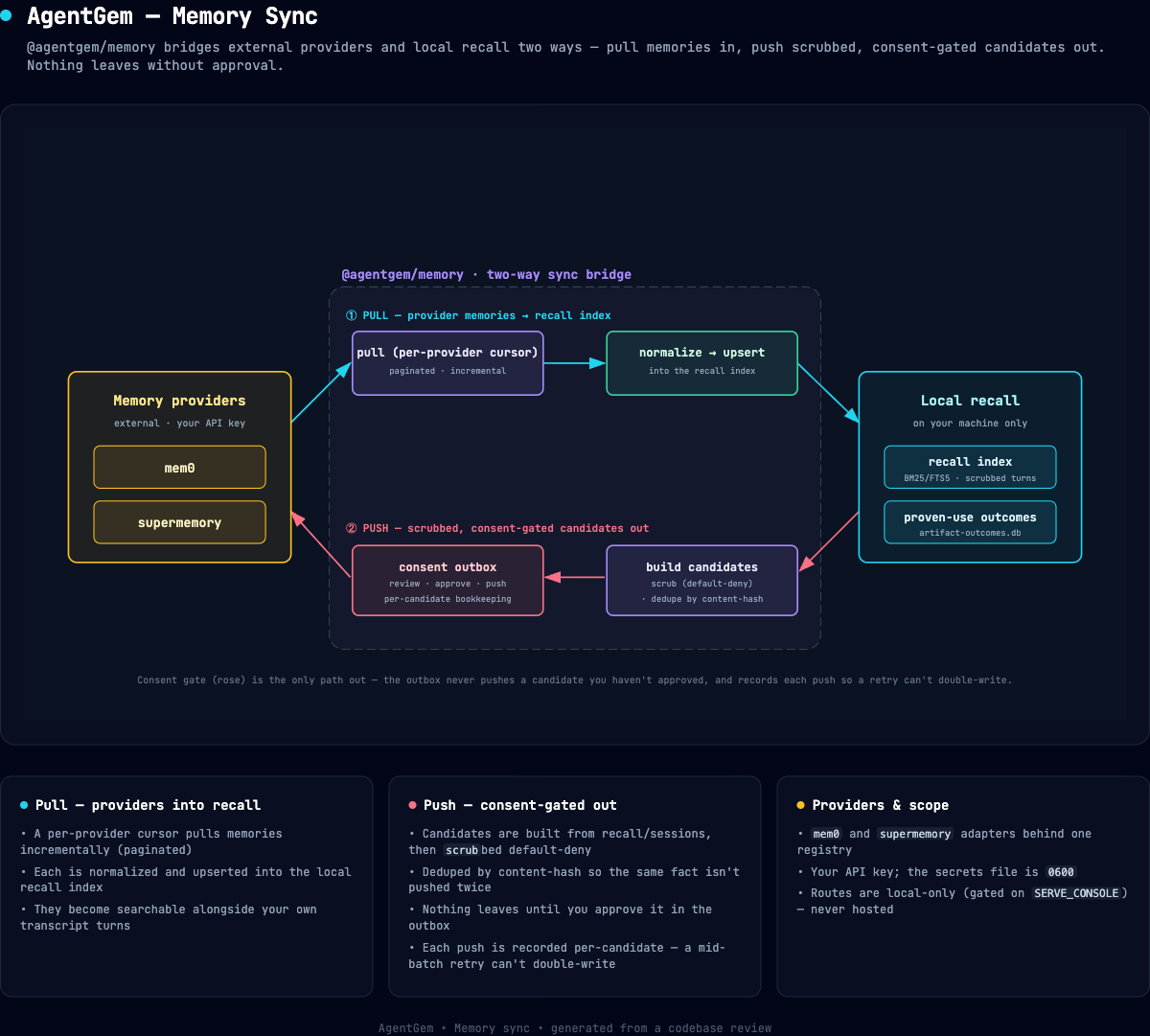
@agentgem/memory) — bridges the recall index to external AI memory providers (mem0, supermemory) two ways: pull their memories into recall, and push scrubbed, consent-gated candidates out through a review outbox. Routes are local-only (gated onSERVE_CONSOLE), never hosted.
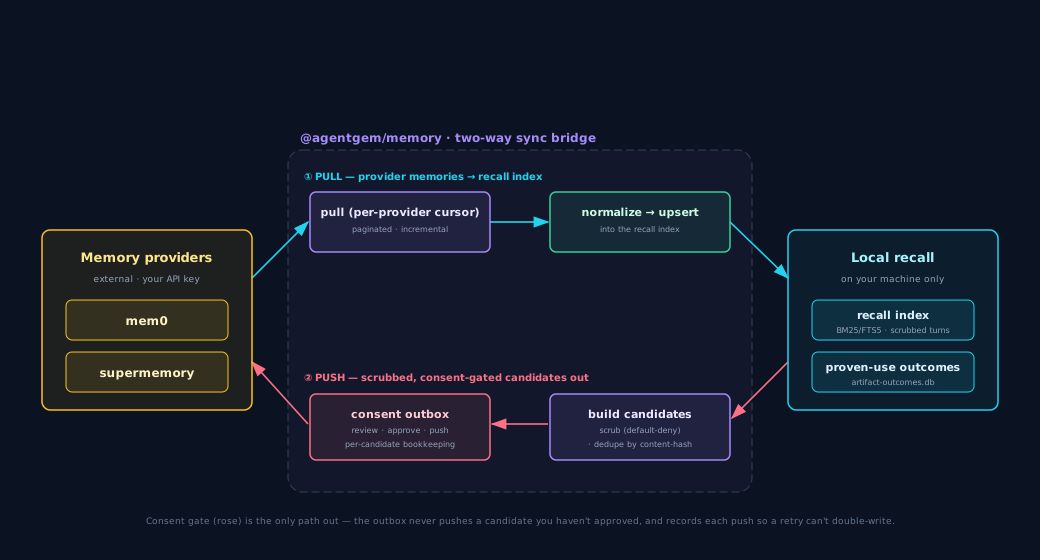
Diagram:
diagrams/memory-sync.svg· PNG · interactive HTML (Copy / PNG / PDF export)
Distribution
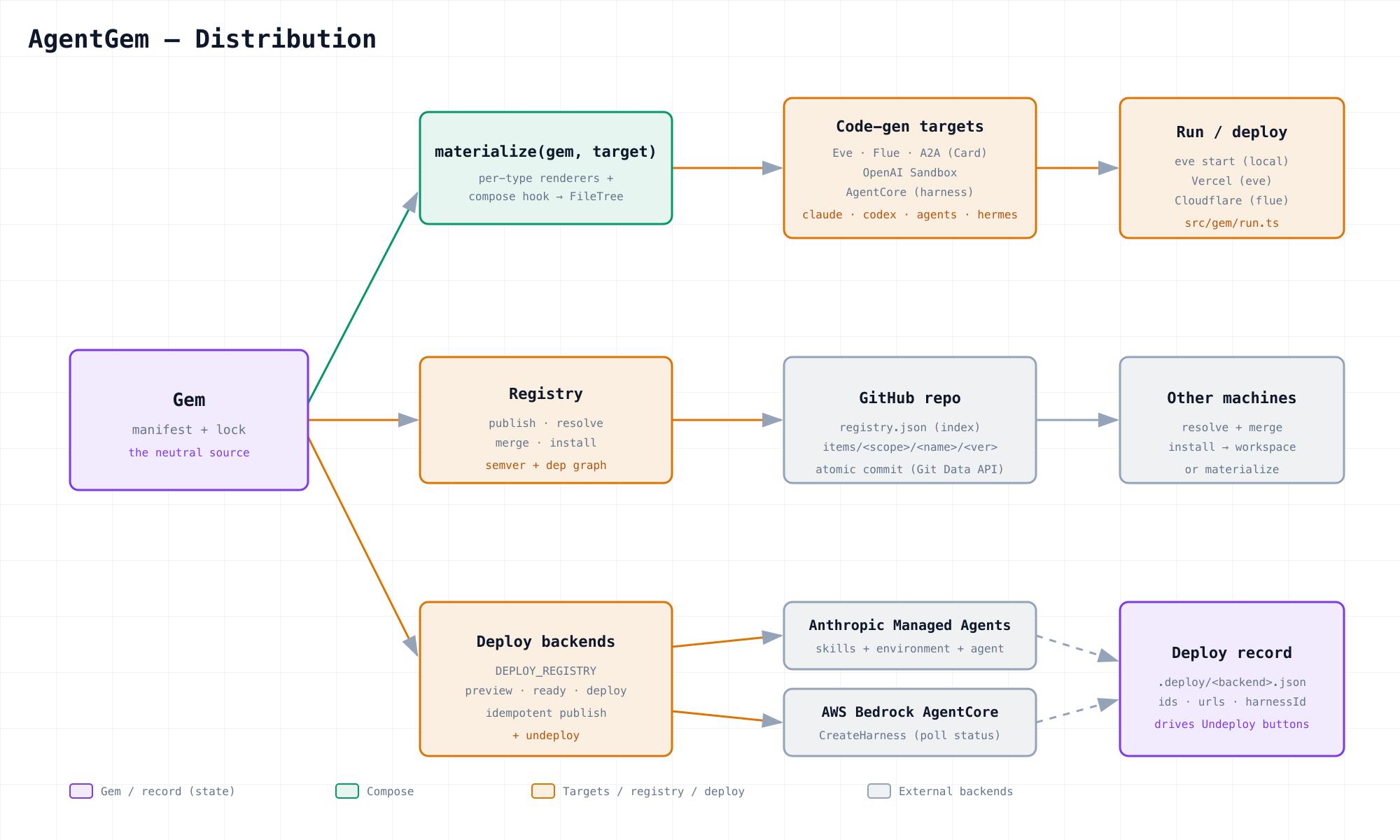
The Gem is a neutral source, consumed by targets and the marketplace, plus local testbeds and runs.
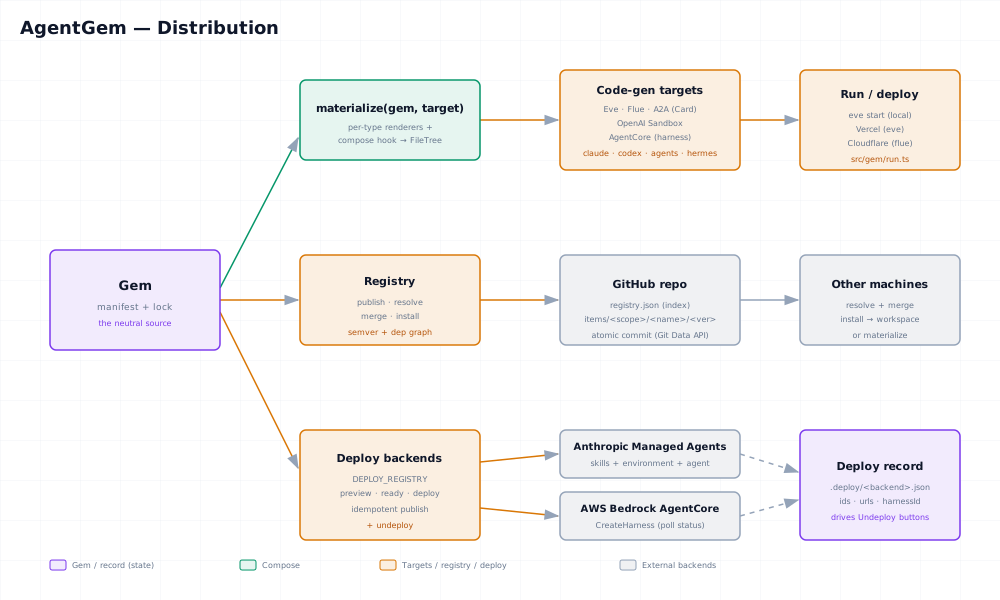
Diagram:
diagrams/distribution.svg· PNG · interactive HTML
- Targets (
@agentgem/model) —materialize(gem, target)runs per-artifact renderers and a cross-cuttingcomposehook to emit aFileTree. Code-gen targets: Eve, Flue, OpenAI Sandbox, AgentCore, and A2A (an Agent Card projection with an opt-in runnable server) — plus the editor targets claude/codex/agents/hermes. See Targets. - Marketplace (
@agentgem/distribute,@agentgem/contract) — publish to and install from the hosted marketplace at app.agentgem.ai, over the same archive format. See Sharing & identity. - Testbed & Run (
@agentgem/testbed,@agentgem/run) — install a Gem into a local.claude/.codex/.hermestestbed, or run a materialized project locally. See Testbed & run.
Source layout
The published npm package is CLI-only (agentgem, agentgem-distill); at pack time
scripts/bundle-bins.mjs esbuild-inlines the @agentgem/* packages into the bins so the
tarball is self-contained (the in-repo build uses loose dist/ + workspace links).
src/                  # the thin server layer — consumes @agentgem/* via workspace deps
  index.ts            # AgentBack wiring: REST + MCP + Explorer on one app (server entry)
  client.ts           # desktop client-mode entry — no auth/DB, benchmark proxy
  cli.ts              # `agentgem` bin — starts the server
  gem.controller.ts   # REST surface (@api) — /api/*
  gem.tools.ts        # MCP-over-HTTP surface (@mcpServer) — /mcp
  share.proxy.controller.ts · benchmark.proxy.controller.ts   # proxies to the hosted marketplace
  schemas.ts          # Zod schemas shared across surfaces
  *.stream.schema.ts · sse/pump.ts   # SSE via agentback streamOf routes (insights, workflow, rubric, scorecard, gem run/verify)
  distill/mcpServer.ts # `agentgem-distill` bin — stdio MCP (MCPApplication + @tool)
  goldmine/           # session intelligence — recall search, chat, and the
    mcpServer.ts      #   `agentgem-goldmine` bin (aggregates-only MCP over past sessions)
    recallRoutes.ts · chatRoutes.ts
  warm/               # `agentgem warm` precompute daemon + launchd/systemd service + hygiene nudge
  play.controller.ts  # Play miniapps REST surface — /api/play/*
  bind/               # `agentgem bind` device-flow auth
packages/             # the Gem core — 15 @agentgem/* workspace packages (see table above)
  console/            # the React console SPA
  memory/             # two-way memory-provider sync (mem0, supermemory)
desktop/              # Electron host — forks a client-mode core (tray + auto-update)
docs/
  diagrams/           # .svg (for docs), .png (fallback), .html (interactive export)
Where to go next
- The build pipeline — introspect → redact → buildGem → archive
- Archive format — the manifest + lock spec
- Redaction — the trust boundary and its rules
- API reference — every REST endpoint and MCP tool
- Targets · Testbed & run
- Development — build, test, and contribute